Why are two slabs of the same stone different?

The nature of natural stone

Anyone choosing natural stone soon encounters a simple but surprising fact: no two slabs of the same material are ever identical. This can be unexpected for those accustomed to perfectly replicated industrial surfaces, but it is one of the most authentic qualities of stone. Understanding this aspect helps to read the material correctly and to make more informed design choices.

An evolving block, a unique slab

Each slab is different because it comes from a block that is never homogeneous. Natural stone is made up of veins, inclusions and stratifications that develop and change in space. Cutting a block essentially means “slicing” a three-dimensional structure in continuous evolution: even consecutive slabs can show variations, sometimes subtle, sometimes more pronounced.

This variability is neither random nor defective, but the direct result of the geological processes that formed the material over time. It is precisely this internal complexity that makes every slab unique.

The case of bookmatching

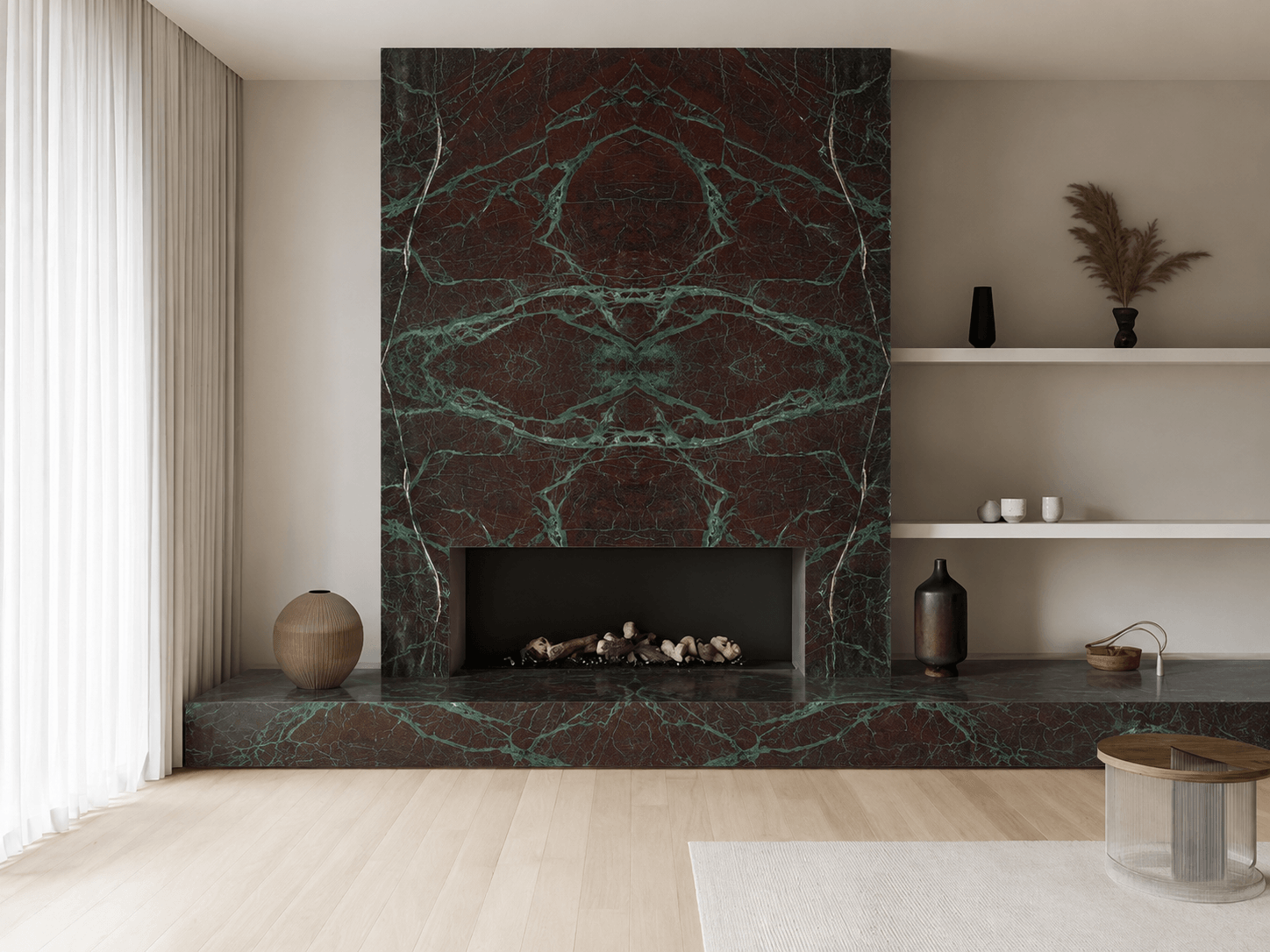
The only apparent exception to this rule is represented by bookmatched slabs. In this case, the two mirrored faces obtained from the same cut are used, resulting in visually similar surfaces because they are reflections of one another.

Even here, however, we are not dealing with absolute identity, but with a geometric correspondence. The similarity comes from symmetry, not from true material repeatability: stone remains a natural, non-serial material.

Credits: Matteo Bianchessi

Credits: Image credits belong to their respective owners

From controlling form to choosing a feeling

When working with natural stone, it makes little sense to choose a material expecting it to be an exact copy of a photograph, another slab or a predefined idea. There is no real “I want it exactly like this”.

The choice should be perceptive rather than geometric: stone is not selected by controlling every vein, but for the overall feeling it conveys, for its character and for how it interacts with space. Very often, once the material is cut and installed, differences that seemed crucial become hardly noticeable.

Diversity as the signature of the material

Variability is not a limitation of natural stone, but its signature. It is what makes it alive, recognisable and impossible to truly replicate. Embracing it means entering into a dialogue with the material, allowing its nature to guide the project rather than forcing it into an artificial idea of perfection.

Discover how our stones have brought emotion into spaces, through projects where material, architecture and design sensitivity come together.