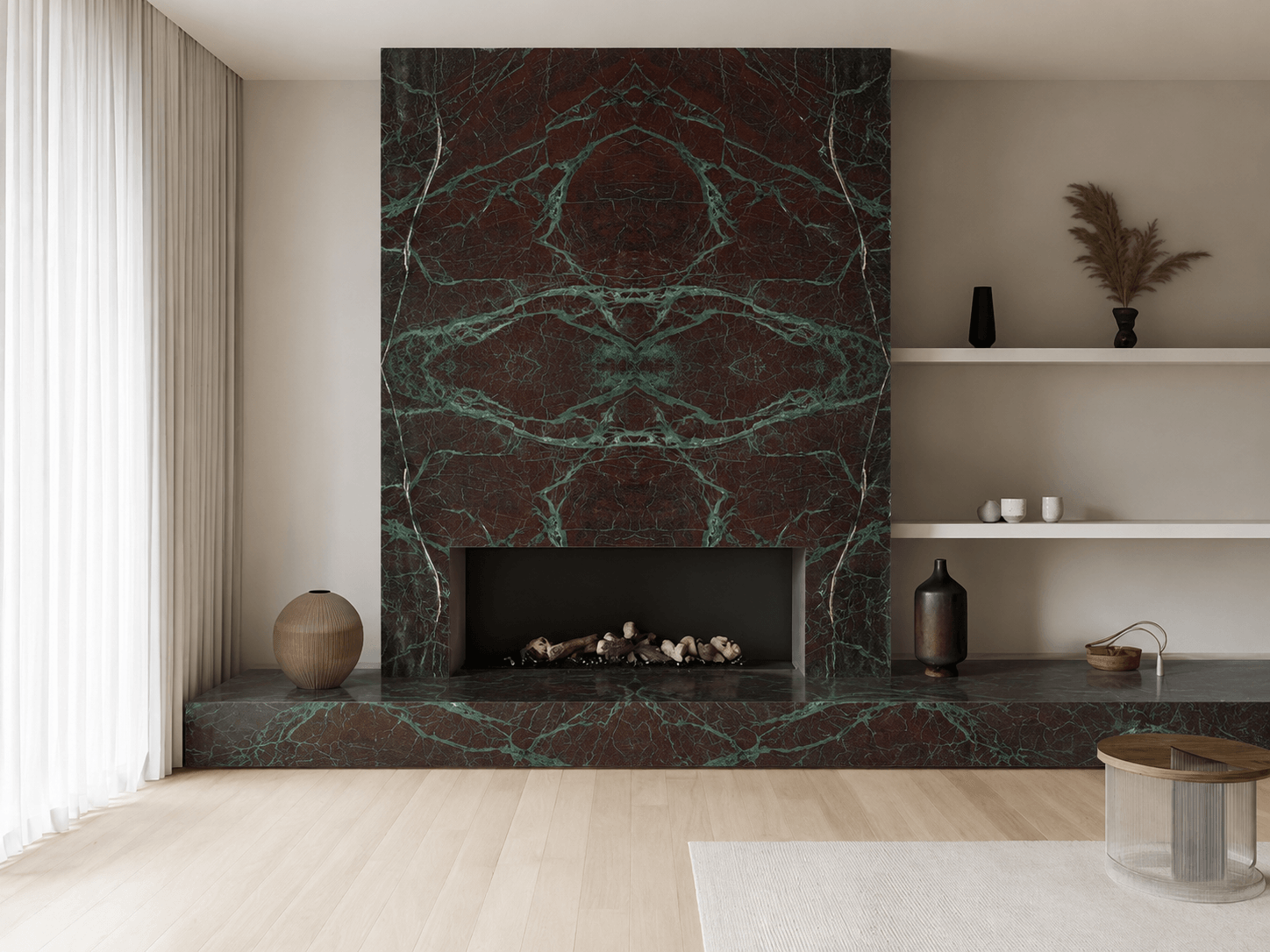
Honeycomb panels for natural stone

Lightening stone without compromising performance

Honeycomb panels are designed to lighten and reinforce natural stone materials. They represent a technical solution that makes it possible to use stone in contexts where, due to weight, thickness or performance requirements, it would otherwise not be feasible. The application of a support panel allows the stone thickness to be reduced to just a few millimetres, expanding its range of use without compromising its aesthetic appearance. The visible surface remains natural stone, while mechanical and functional performance is entrusted to the composite system as a whole.

Credits: Luca Morandini

The lightweight system: stone, adhesive and panel

When talking about honeycomb panels, it is not simply a matter of adding a backing to the stone, but of creating a new construction system. The product that is actually installed is the combination of stone, adhesive and panel, working together as a single unit.
It is this system, as a whole, that must meet the project’s performance requirements: mechanical strength, dimensional stability, behaviour in humid conditions, water resistance, and long-term durability. Discover how honeycomb panels made the Very Simple Kitchen × Tekla bicolor countertop project possible. Especially in complex projects, such as large interior surfaces, façades or special cladding, the overall behaviour of the system becomes more important than that of the individual material.

Credits: Matteo Bianchessi

Design variables

Designing a lightweight natural stone system depends on a number of variables that must be carefully evaluated. The application context is the first factor to consider. Environmental conditions, temperature fluctuations, thermal expansion, humidity, solar exposure or weathering, directly influence the performance required of the finished system. Next come the characteristics of the natural stone itself, which may vary in terms of absorption, elasticity, colour, internal structure and, in some cases, translucency. These properties affect both the choice of panel and the most suitable adhesive.
Finally, the assembly process plays a key role. A system produced in an industrial environment, with controlled temperatures, mechanised adhesive application and stable bonding conditions, delivers different results compared to a manual process, where the operator’s expertise becomes decisive.

Types of panels

Honeycomb panels are generally sandwich substrates, consisting of an internal core and two outer skins. The core may be made of aluminium honeycomb, polypropylene honeycomb or PET foam. The density depends on the cell size: the finer the grid, the greater the structural resistance. Panel thickness also affects performance, typically ranging from 4 to 20 mm. With the same material, greater thickness corresponds to higher structural capacity. Standard panel sizes usually reach up to approximately 1550 × 3050 mm.

Aluminium honeycomb panel with fiberglass skins

This is one of the most widely used supports for natural stone. It offers high stability and excellent performance, and is suitable for both indoor and outdoor applications. The balance between lightness and strength makes it a highly versatile system.

Honeycomb panel with aluminium skins

This panel provides additional strength thanks to the metal skins and contributes to the system’s fire-resistant properties. It can be used both indoors and outdoors, but is not recommended where strong thermal stresses are present, as aluminium expansion must be compensated by specific adhesives capable of absorbing it.

Aluminium honeycomb panel with fire-retardant fiberglass skins

This is a treated variant that preserves the system’s fire-resistant properties without compromising its structural performance.

Polypropylene panel

A compact, highly resistant and fully closed support, therefore non-absorbent. It is suitable for all natural stone materials and is also used in backlit applications.

PET foam panel with fiberglass skins

This panel is lightweight, rigid and visually neutral. It is particularly suitable for backlighting, even with highly translucent stones, as it does not transfer the honeycomb pattern to the surface, which can sometimes be visible with other supports.

PET foam panel with aluminium skins

This type of panel is most commonly used where a lightweight support with minimal thickness is required, with careful attention to cost control. Compared to honeycomb systems, it does not offer the same structural performance, but allows for thin, functional panels in applications with limited loads and stresses. The aluminium skins provide good surface stability, making this solution suitable where the priority is a balance between lightness, construction simplicity and system rationalisation.

Fiberglass

Fiberglass represents an effective solution when a minimum-thickness system is required. In this case, the natural stone slab is reduced to very thin sections, generally around 5 mm, and reinforced on the back through a resin bonding process with fiberglass. The result is a lightweight and compact system, in which the fiberglass provides structural containment and stabilisation, made possible by the extremely low weight of the stone. This solution is suitable where it is essential to minimise overall thickness while maintaining the visual continuity of natural stone.

Fixing systems

Depending on the project and panel type, lightweight systems can be bonded or mechanically fixed using anchors and dedicated substructures. A wide range of fixing solutions exists to meet different requirements in terms of safety, installation accuracy and maintenance.

Performance and lightness in natural stone

Honeycomb panels are now a fundamental tool for expanding the use of natural stone in contemporary design.
They are not merely a lightening solution, but a true technical system, in which materials, adhesives and supports work together to ensure performance, durability and design freedom. Understanding the variables that govern these systems makes it possible to integrate natural stone into increasingly complex applications, preserving its material identity while enhancing its technical potential.